
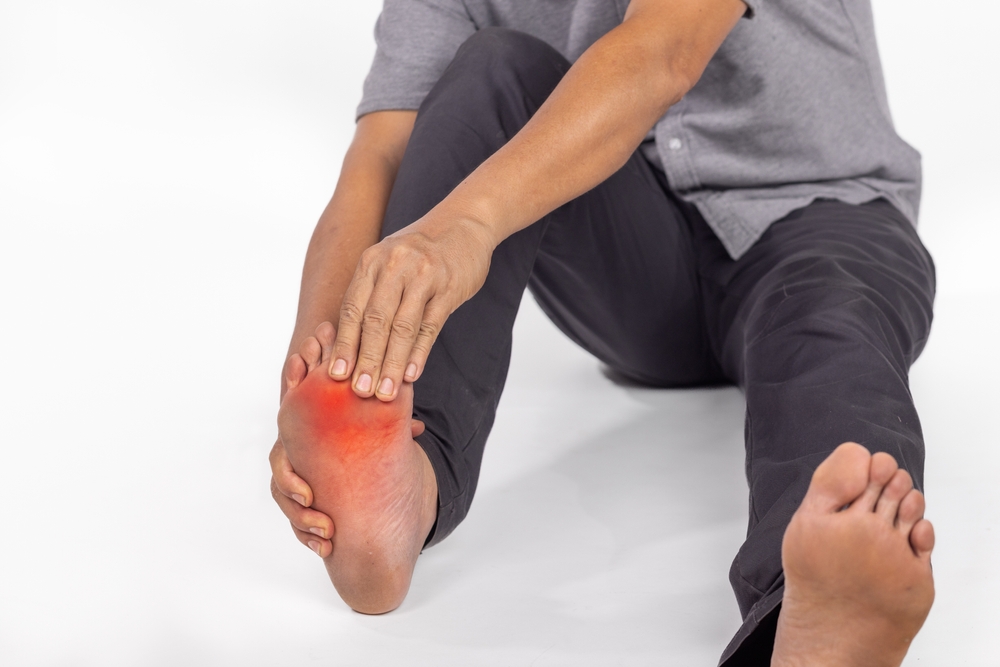
Burning Between Your Toes, a Feeling Like You’re Walking on a Pebble, or Numbness in the Ball of Your Foot
Morton’s neuroma is a thickening and inflammation of the tissue surrounding one of the digital nerves that runs between the metatarsal bones to the toes. Despite the name, it is not a true tumor — it is a compressive neuropathy caused by chronic irritation and entrapment of the nerve beneath the deep transverse metatarsal ligament. The result is a nerve that becomes swollen, scarred, and painful, producing a characteristic combination of burning, tingling, numbness, and the sensation of a foreign object under the forefoot.
Most neuromas develop between the third and fourth metatarsal heads (the most common location), though the second and third interspace is also affected. Our podiatrists diagnose and treat Morton’s neuroma at our Coon Rapids and Golden Valley offices, serving patients across the north and west metro including Maple Grove, Champlin, Blaine, Plymouth, Wayzata, Minnetonka, and Edina.
The “pebble in the shoe” sensation — the feeling that something is bunched up under the ball of the foot — is one of the most recognizable symptoms in podiatry. If you have this, combined with burning or numbness between the third and fourth toes, a Morton’s neuroma is the most likely explanation. The good news: most neuromas respond well to conservative treatment without surgery.
Call 763-421-7300 or book online
What Is Morton’s Neuroma?
The digital nerves of the foot run between the metatarsal bones toward the toes, passing beneath a tight band of tissue called the deep transverse metatarsal ligament. When repetitive compression, forefoot crowding, or biomechanical stress irritates the nerve at this passage point, the nerve sheath thickens, fibrosis develops, and the surrounding tissue becomes inflamed. This is the neuroma — not a tumor, but a reactive swelling of an entrapped, chronically irritated nerve.
The third intermetatarsal space is affected in the majority of cases because the nerve at this location is formed by the junction of two nerve branches, making it slightly larger and more vulnerable to impingement. The second interspace is the next most common location. True first or fourth interspace neuromas are less common and should prompt consideration of alternative diagnoses.
Morton’s neuroma vs. metatarsalgia: metatarsalgia is diffuse pain and aching across the ball of the foot at the metatarsal heads, caused by overload and pressure distribution issues. Morton’s neuroma produces neurological symptoms — burning, tingling, numbness, and the pebble sensation — in a specific interspace rather than diffusely. Both can coexist. If your ball-of-foot pain is aching and pressure-related without neurological symptoms, metatarsalgia may be the primary diagnosis. See our Metatarsalgia page.
Causes & Risk Factors
- Narrow or tight footwear: the most common contributing factor. A narrow toe box compresses the metatarsal heads together, squeezing the intermetatarsal nerve and accelerating fibrosis.
- High heels: transfer body weight onto the forefoot and increase the compressive forces at the metatarsal heads with every step.
- High-impact activity: running and court sports subject the forefoot to repeated impact loading that irritates the nerve over time.
- Foot structure: flat feet, high arches, bunions, and hammertoes all alter forefoot mechanics and can increase nerve compression in the intermetatarsal space.
- Repetitive forefoot loading: occupations or activities requiring prolonged standing on hard surfaces or repetitive forefoot pressure.
Symptoms
- A burning, shooting, or electric pain between the toes, most often between the third and fourth
- Numbness or tingling in the affected toes
- A sensation of walking on a pebble, marble, or bunched-up sock that does not go away when you check your shoe
- Pain that worsens during activity and improves with rest and removal of shoes
- Relief when you squeeze the forefoot laterally or remove tight shoes, and worsening when you put them back on
- In more advanced cases: constant burning even at rest, or persistent numbness between the toes
The Mulder’s click: a distinctive clinical test for Morton’s neuroma. The examiner squeezes the forefoot from side to side while simultaneously pressing upward between the metatarsal heads. In a positive test, a palpable and sometimes audible click is produced as the swollen nerve is forced through the intermetatarsal space. A positive Mulder’s click with the characteristic symptom history is highly suggestive of neuroma. If your symptoms match but this test has not been performed, ask for it at your evaluation.
Diagnosis
Diagnosis is clinical in most cases, combining the characteristic symptom pattern with the Mulder’s click test, localized palpation tenderness in the interspace, and assessment of the overall forefoot mechanics and alignment. We also evaluate for concurrent conditions — hammertoes, bunions, or metatarsalgia — that may be contributing to forefoot crowding.
- Diagnostic ultrasound — performed in-office. Confirms the neuroma, measures its size, and guides injection placement. Neuroma size on ultrasound correlates with symptom severity and can help predict which patients will respond to conservative management vs. those more likely to need surgery.
- MRI — occasionally used when the diagnosis is uncertain or when concurrent soft tissue pathology needs to be excluded.
- X-ray — does not image the nerve but helps exclude bony causes of forefoot pain and identify structural contributors such as a bunion or metatarsal alignment issue.
Treatment at Family Foot & Ankle Clinic
Treatment follows a graduated approach. The majority of Morton’s neuroma patients respond to conservative management and do not require surgery.
Tier 1 — Conservative Management
Footwear modification. The most important first step. A wide toe box that does not compress the metatarsal heads eliminates the primary mechanical driver of nerve irritation. Low-heeled shoes with adequate forefoot cushioning reduce impact loading. See our Shoe Recommendations Guide for specific current picks.
Metatarsal pad. A small pad placed just behind the metatarsal heads redistributes forefoot load away from the compressed interspace, reducing nerve irritation with every step. Available as an adhesive pad or built into a custom orthotic. Metatarsal pad products and neuroma-specific padding are available through our office or from MyFootShop.com — see our Morton’s Neuroma Patient Guide below for specific product guidance.
Custom orthotics. For patients with flat feet, high arches, or other structural contributors, a custom orthotic addresses the biomechanical cause of nerve compression, provides sustained metatarsal support, and is more durable than adhesive padding. More on our Custom Orthotics page.
Activity modification. Reducing high-impact forefoot loading activities — running, court sports, prolonged standing on hard surfaces — allows the acute inflammation to settle while conservative measures take effect.
Tier 2 — Injection Therapy
Corticosteroid injection. An ultrasound-guided injection of corticosteroid into the affected interspace reduces inflammation around the nerve and provides significant pain relief. Many patients experience lasting relief from one to three injections. Ultrasound guidance ensures precise placement into the interspace rather than adjacent tissue, which meaningfully improves outcomes compared to landmark-based injection.
Tier 3 — Surgical Excision
Surgery is recommended when conservative treatment and injection therapy have not provided adequate relief, or for patients with a large neuroma (typically ≥5 mm on ultrasound) that is unlikely to respond to conservative care alone.
- Dorsal approach (top of foot): the most common surgical approach. A small incision is made on the top of the foot between the metatarsal heads, and the neuroma is excised. The patient can walk immediately in a surgical shoe. Scar does not form on the weight-bearing surface.
- Plantar approach (bottom of foot): allows direct visualization of the nerve from below. Excellent exposure, but the plantar scar requires longer off-loading to prevent a painful scar on the weight-bearing surface.
Important: neurectomy (surgical excision) permanently removes the segment of nerve, leaving numbness in the adjacent toes. This is expected and typically well-tolerated. Patients should be aware of this before surgery.
See our Foot & Ankle Surgery Overview for general information on surgical care at our clinic.
Frequently Asked Questions
Do I need surgery for a Morton’s neuroma?
Most patients do not. The majority of Morton’s neuromas respond to a combination of footwear modification, metatarsal padding, custom orthotics, and one or two corticosteroid injections. Surgery is reserved for neuromas that fail an adequate course of conservative management, typically defined as 3–6 months of appropriate treatment including injection therapy. A neuroma that is very large on ultrasound is less likely to respond to conservative care and may warrant earlier surgical discussion.
Will my neuroma go away on its own?
Unlikely without addressing the causes. A neuroma that continues to be compressed by tight footwear or forefoot loading will continue to enlarge and become more symptomatic. A neuroma managed with appropriate footwear, padding, and occasional injection therapy can remain stable and comfortable for years. Without any intervention, most neuromas progressively worsen.
What is the numbness between my toes after neuroma surgery?
Permanent partial numbness in the skin between the adjacent toes is an expected outcome of neurectomy — the nerve has been removed and sensation in the area it supplied is permanently reduced. Most patients find this trade-off acceptable given the relief from the neuroma pain. The area of numbness is typically small and does not interfere with normal foot function. It should be discussed and understood before surgery.
I have ball-of-foot pain but my imaging was normal. Could it still be a neuroma?
Yes. Small neuromas can be missed on MRI if the study is not specifically optimized for forefoot nerve imaging, and ultrasound is more sensitive for dynamic neuroma assessment. A negative scan with a classic symptom history and positive Mulder’s click still warrants a diagnostic injection, which both confirms the diagnosis and provides treatment. If you have been told your imaging is normal but symptoms persist, our Second Opinion / Foot Pain Not Improving visit is appropriate.
Burning or Numbness in the Ball of Your Foot? Most Neuromas Are Treatable Without Surgery.
A thorough evaluation — including in-office ultrasound to size the neuroma and confirm the diagnosis — takes the guesswork out of the treatment plan. Book an appointment at our Coon Rapids or Golden Valley office and we will tell you exactly what you are dealing with and what the right next step is.
Call 763-421-7300 or book online
Serving Coon Rapids, Golden Valley, Maple Grove, Champlin, Blaine, Plymouth, Andover, Wayzata, Minnetonka, Edina, and all Twin Cities communities.