
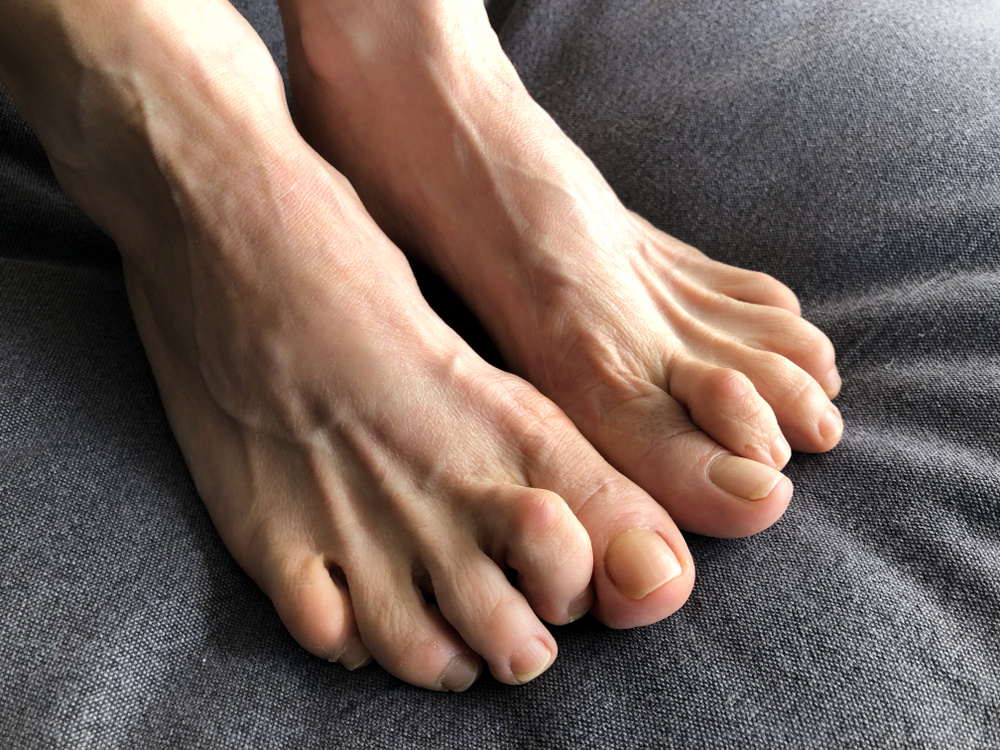
Toes That Curl, Cross, or Rub — and Why They Keep Getting Worse
A hammertoe is a deformity of the smaller toes in which the toe bends abnormally at the middle joint, causing it to curl downward rather than lying flat. The result is a toe that looks like an upside-down V from the side — raised at the middle joint, with the tip pointing down and the top of the toe rubbing against the inside of shoes with every step.
Hammertoes are one of the most common forefoot problems we see, and they share a critical feature with bunions: they are progressive. A hammertoe that is flexible and moveable today will become rigid and fixed if left untreated. The window for non-surgical correction is the flexible stage. Once the deformity becomes rigid, surgery is the only way to straighten the toe. Our podiatrists diagnose and treat hammertoes at our Coon Rapids and Golden Valley offices, serving patients across the north and west metro including Maple Grove, Champlin, Blaine, Plymouth, Wayzata, Minnetonka, and Edina.
The most important thing to know: treat a flexible hammertoe while it is still flexible. A toe you can manually straighten today may become permanently contracted within months to years. Early conservative treatment — correct footwear, padding, and splinting — can slow or halt progression and delay or avoid surgery.
Call 763-421-7300 or book online
What Is a Hammertoe — and How Is It Different from a Mallet Toe or Claw Toe?
All three are toe deformities caused by muscle and tendon imbalance, but they affect different joints:
| Condition | Joint Affected | What It Looks Like | Most Common Toe |
| Hammertoe | Proximal interphalangeal joint (PIP) — the middle toe joint | Toe bent upward at the middle joint; tip pointing down. Classic “upside-down V” shape. | 2nd toe most common; can affect any lesser toe |
| Mallet toe | Distal interphalangeal joint (DIP) — the end toe joint | Only the tip of the toe bends downward; rest of toe is relatively straight. | 2nd toe most common |
| Claw toe | Both PIP and DIP joints | Toe bent at both the middle and end joints, curling the entire lesser digit downward like a claw. MTP joint often elevated. | All four lesser toes, often simultaneously |
In practice, “hammertoe” is often used informally to describe all three, and the management principles overlap. We will specify the exact joint involvement at your visit.
Flexible vs. Rigid — The Classification That Determines Treatment
The single most important question about a hammertoe is whether it is still flexible:
- Flexible hammertoe: the deformity is present but the toe can be manually straightened — when you push it flat, it returns to a normal position. The tendons and joint capsule are tight but not yet permanently contracted. Conservative treatment can slow progression and in some cases maintain the toe in a more functional position. Splinting and strapping are meaningful interventions at this stage.
- Rigid (fixed) hammertoe: the toe cannot be straightened manually. The tendons have contracted permanently and the joint has adapted to the deformed position. Conservative treatment manages symptoms — padding, footwear, callus care — but cannot correct the alignment. Surgery is the only option for structural correction at this stage.
Do not wait until your hammertoe is rigid to seek treatment. A flexible hammertoe that receives appropriate conservative management — correctly fitting footwear, toe splinting, orthotics to address the driving biomechanics — can remain flexible and manageable for many years. The same hammertoe ignored or mismanaged can become rigid within 12–24 months.
What Causes Hammertoes?
Hammertoes develop from an imbalance between the intrinsic foot muscles (which straighten and stabilize the toes) and the stronger extrinsic calf muscles (which flex and extend the toes). When intrinsics are overpowered, the extrinsic tendons pull the toe into a bent position. Over time the tendons shorten and the joint capsule tightens, locking the deformity in place. Contributing factors:
- Bunion (hallux valgus): the most common driver of second toe hammertoe. As the big toe drifts toward the second toe, it crowds the second toe upward into a hammered position. This is not a coincidence — it is a direct biomechanical consequence.
- Long second toe: a second toe longer than the first is more prone to buckling under the shoe’s toe box.
- Tight or narrow footwear: compresses the forefoot and forces toes into a bent position, accelerating contracture.
- Flat feet or high arches: alter extrinsic tendon mechanics and predispose to hammertoe formation.
- Neurological conditions or prior injury: Charcot-Marie-Tooth disease, stroke, and compartment syndrome can disrupt the muscle balance that keeps toes flat.
Symptoms
- A visible bend or curl in one or more of the lesser toes
- Pain or pressure on the top of the bent joint where it rubs against the shoe
- A corn or callus on top of the PIP joint from repeated shoe friction — one of the most common reasons patients present
- Callus or pain under the ball of the foot at the metatarsal head, where the elevated MTP joint transfers load downward
- Difficulty finding comfortable shoes, particularly in the toe box
- Redness, swelling, or an open sore at the corn site in more advanced cases or in diabetic patients
In diabetic patients: hammertoes represent a serious risk. The combination of neuropathy (reduced sensation), poor circulation, and abnormal pressure from the deformity can lead to ulceration and infection. Any diabetic patient with a hammertoe should be evaluated promptly — this is not a wait-and-see condition in the diabetic foot.
Diagnosis
We assess each affected toe for flexibility, identify which joints are involved, and evaluate the entire forefoot for concurrent conditions — particularly bunion deformity at the first metatarsal, neuroma, or metatarsalgia. Weight-bearing X-rays show the position of each toe in its functional state and identify any arthritic changes in the involved joints that would affect surgical planning.
Treatment at Family Foot & Ankle Clinic
Conservative Management — Flexible Hammertoes
Footwear modification. The most impactful immediate change. A shoe with a deep, wide toe box gives the toe room to sit without constant pressure on the bent joint. Rocker-sole shoes reduce forefoot bend during walking and decrease pressure at the metatarsal heads. High heels and pointed toe boxes worsen every hammertoe and should be avoided during symptomatic periods.
Toe splinting and strapping. A toe straightening splint or buddy strap can hold a flexible hammertoe in a more anatomic position during activity and help slow contracture development. Most effective in early, flexible deformities where the toe can still be manually straightened.
Padding. Hammer toe pads and corn cushions placed on the top of the bent joint reduce friction against the shoe upper. Metatarsal pads placed behind the metatarsal heads reduce ball-of-foot pressure. Available through our office or from MyFootShop.com.
Custom orthotics. For patients with flat feet, bunion deformity, or other biomechanical contributors, a custom orthotic addresses the root cause of the toe’s abnormal loading pattern. A metatarsal pad built into the orthotic can redistribute pressure away from the painful joints. More on our Custom Orthotics page.
Callus and corn care. We debride painful corns and calluses in-office, which provides significant short-term relief. Recurring corns are a symptom of the deformity — they will return unless the underlying pressure is addressed through footwear or surgery.
Surgical Correction — Flexible and Rigid Hammertoes
Surgery is recommended when a flexible hammertoe is progressing despite conservative management, or when a rigid hammertoe is causing significant pain or functional limitation. The procedure depends on whether the deformity is flexible or rigid:
- Flexible hammertoe — tendon release or transfer: the contracted extensor or flexor tendon is released or repositioned to allow the toe to lie flat. The joint is preserved. Recovery typically 2–4 weeks in a surgical shoe.
- Rigid hammertoe — arthroplasty: the head of the proximal phalanx is resected to release the fixed contracture. A temporary K-wire may hold the toe during healing. Recovery typically 4–6 weeks.
- Rigid hammertoe — arthrodesis (fusion): the PIP joint is fused in a straightened position using an intramedullary implant or K-wire. More durable correction for advanced rigid deformities. Recovery 6–8 weeks.
When a hammertoe is secondary to a bunion, bunion correction is typically performed at the same time — correcting only the hammertoe without addressing the bunion that caused it results in recurrence.
See our Foot & Ankle Surgery Overview for general information on surgical care at our clinic.
Frequently Asked Questions
Can hammertoes be fixed without surgery?
Flexible hammertoes can be managed conservatively and their progression slowed, but the underlying muscle imbalance cannot be reversed without surgery. The realistic goal of conservative treatment is to keep the toe comfortable and functional for as long as possible. Once a hammertoe becomes rigid — the toe can no longer be manually straightened — surgery is the only path to structural correction.
My second toe is crossing over the first. Is that a hammertoe?
Crossover toe is related but involves additional instability of the second metatarsophalangeal (MTP) joint, often with a plantar plate tear. The toe drifts medially (toward the big toe) and elevates, eventually crossing over. It shares some features with hammertoe but the treatment, particularly surgically, differs. We evaluate both the joint and the plantar plate to determine the right approach.
Do I need to fix my bunion at the same time as my hammertoe?
If your hammertoe developed because of a bunion — the big toe pushing the second toe out of position — then yes, correcting the hammertoe alone without correcting the bunion usually leads to recurrence. We typically address both in the same surgical setting when they are causally related. If the hammertoe developed independently of a bunion, it can be corrected in isolation.
How long is hammertoe surgery recovery?
Most patients are in a surgical shoe for 3–6 weeks and return to regular footwear at 6–8 weeks. Return to full activity is typically 8–12 weeks. Recovery is longer when combined with bunion surgery. If you have been quoted a significantly longer recovery timeline and want to understand your options more fully, our Second Opinion / Foot Pain Not Improving visit is available.
Bent Toes Causing Pain or Shoe Problems? The Sooner We See It, the More Options You Have.
Hammertoes are easier to treat at the flexible stage than the rigid stage. Book an appointment at our Coon Rapids or Golden Valley office and we will tell you exactly where your toe is in that progression and what the right next step is.
Call 763-421-7300 or book online
Serving Coon Rapids, Golden Valley, Maple Grove, Champlin, Blaine, Plymouth, Andover, Wayzata, Minnetonka, Edina, and all Twin Cities communities.