
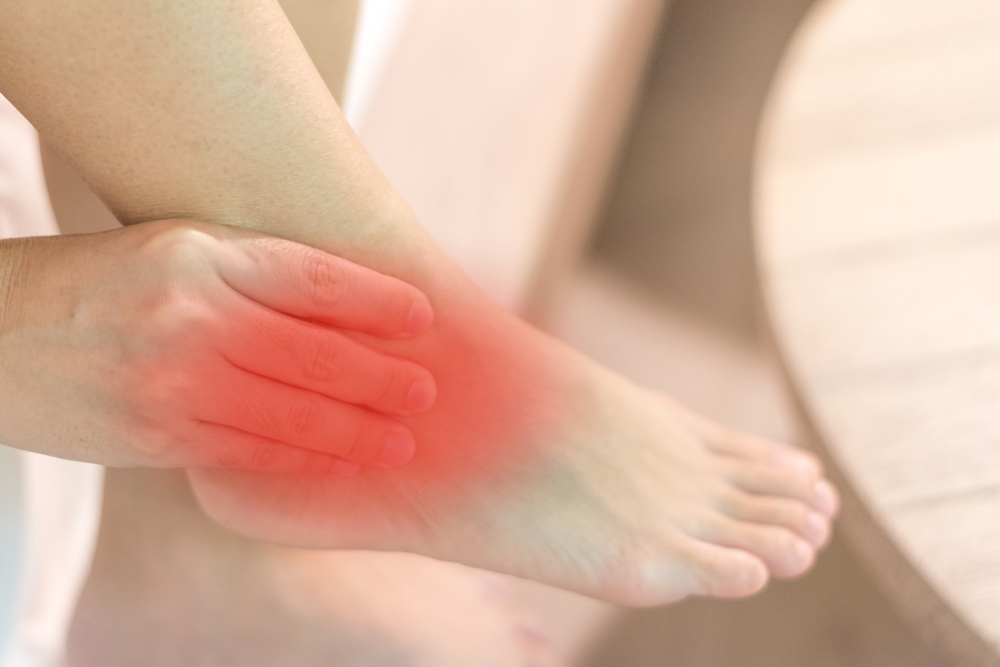
A Pop, a Drop, and You Can’t Push Off — This Is an Emergency
An Achilles tendon rupture is one of the most significant musculoskeletal injuries in sports and everyday life. It happens suddenly — a sharp pop, a sensation of being kicked or struck from behind, and then the inability to push off or stand on the toes of the affected foot. The Achilles is the largest and strongest tendon in the body, and when it ruptures, walking is immediately compromised.
Most ruptures occur in men aged 30–50 during recreational sport — the classic “weekend warrior” mechanism — but they can happen to anyone. The good news is that with appropriate management, most patients return to full function. The decision between surgical repair and non-surgical rehabilitation is the central question, and the right answer depends on factors specific to each patient.
This is a time-sensitive injury. If you suspect an Achilles rupture, seek evaluation the same day or next day. Do not bear weight on the affected foot. Keep the ankle in a plantarflexed (toes-down) position — elevate the heel with a pillow when lying down. Earlier assessment and earlier initiation of management — whether surgical or non-surgical — leads to better outcomes. Call us at 763-421-7300 for a same-day appointment or go to urgent care if we are not available.
What Is an Achilles Tendon Rupture?
The Achilles tendon connects the calf muscles (gastrocnemius and soleus) to the heel bone (calcaneus). It transmits the force of calf contraction into push-off with every step, run, and jump. A rupture occurs when the tendon tears partially or completely, most often at the watershed zone approximately 2–6 cm above the calcaneal insertion — the area with the poorest blood supply and highest cumulative mechanical load.
Two types occur:
- Complete rupture: the tendon tears through entirely. The tendon gap is palpable on examination. Push-off power is lost completely. Definitive management is required.
- Partial rupture: the tendon is significantly torn but maintains some continuity. May be more ambiguous on presentation. MRI is often needed to characterize the extent of injury and guide management.
Achilles rupture vs. Achilles tendinopathy: tendinopathy is a gradual-onset degenerative condition causing chronic pain along the tendon. Rupture is acute, sudden, and associated with immediate loss of push-off power. A history of prior Achilles tendinopathy is a significant risk factor for rupture, as degenerated tendon tissue is more vulnerable to complete failure. If you have chronic Achilles pain and experience a sudden worsening, see us the same day.
How Achilles Ruptures Happen
Most ruptures occur with a sudden eccentric load — the calf contracting forcefully while the ankle is simultaneously dorsiflexed — during sport (basketball, tennis, squash, soccer) or with an awkward push-off, stumble, or landing. The classic presentation is the “weekend warrior” in their 30s or 40s who has been less active and then overloads the tendon with sudden demand. Pre-existing risk factors include chronic tendinosis, prior corticosteroid injections near the tendon, fluoroquinolone antibiotic use, and a sudden return to activity after a period of inactivity — all of which weaken the tendon’s structural integrity before the precipitating event.
Symptoms
- A sudden, loud pop or snap at the back of the ankle, often described as feeling like being struck or kicked from behind
- Immediate sharp pain at the back of the heel and lower calf, which may diminish surprisingly quickly
- Inability to rise onto the toes of the affected foot or to push off when walking
- A palpable gap or divot in the tendon approximately 2–6 cm above the heel, visible and felt through the skin
- Swelling and bruising developing within hours along the back of the ankle
- Walking is possible but severely abnormal — flat-footed gait with no push-off
The Thompson test: the bedside clinical test for Achilles rupture. With the patient lying prone (face down), the calf is squeezed. In an intact tendon, the foot plantarflexes (moves downward). In a complete rupture, the foot does not move. A positive Thompson test has high sensitivity and specificity for complete rupture. This test can be performed by anyone — if squeezing the calf produces no foot movement, seek evaluation immediately.
Diagnosis
Clinical diagnosis of a complete rupture is usually straightforward from the history and Thompson test. Imaging adds detail that guides management decisions:
- Ultrasound — may be performed in-office. Confirms rupture, distinguishes complete from partial, identifies the gap size, and shows whether the tendon ends can be approximated with the foot in plantarflexion — a key factor in non-surgical management candidacy.
- MRI — provides the most complete picture of rupture extent, tissue quality, and associated pathology. Used for complex presentations, chronic ruptures, and surgical planning.
- X-ray — not diagnostic for soft tissue rupture, but useful to exclude an avulsion fracture at the calcaneal insertion and to assess bone quality.
Treatment — Surgical vs. Non-Surgical
The most important treatment decision for Achilles rupture is whether to manage surgically or non-surgically. Both approaches can produce good functional outcomes. The right choice depends on patient age, activity goals, rupture characteristics, and overall health.
| Factor | Favors Non-Surgical Management | Favors Surgical Management |
| Patient age and activity level | Older or less active patients; sedentary lifestyle; significant medical comorbidities | Younger or highly active patients; competitive athletes; strong desire for return to sport |
| Re-rupture risk | Willing to accept slightly higher re-rupture rate (reported as 2–5x higher than surgical in some studies) in exchange for avoiding operative risks | Prioritize minimizing re-rupture risk; surgery reduces but does not eliminate re-rupture |
| Rupture gap | Small gap; tendon ends approximate well in plantarflexion on ultrasound | Large gap; poor tendon end apposition even in plantarflexion |
| Skin and wound healing | Poor skin quality, diabetes, peripheral vascular disease, immunosuppression — all increase surgical wound complication risk significantly | Healthy tissue with low wound healing risk |
| Surgeon and patient preference | Strong preference to avoid surgery; access to early functional rehabilitation protocol | Preference for definitive structural repair; high-demand athletic return required |
The evidence base: randomized controlled trials comparing surgical and non-surgical management with accelerated functional rehabilitation have shown comparable functional outcomes, return-to-sport rates, and strength recovery when both groups begin early rehabilitation. The key word is early — non-surgical management that uses prolonged immobilization rather than functional rehabilitation produces significantly worse outcomes than either surgical repair or properly managed non-surgical treatment.
Non-Surgical Management (Functional Rehabilitation Protocol)
Non-surgical management of Achilles rupture has evolved significantly. The old approach of cast immobilization for 8–12 weeks produced poor results. The current evidence-based approach uses early functional rehabilitation:
- Immediate placement in a walking boot with heel wedges, holding the ankle in plantarflexion to approximate the tendon ends
- Early protected weight-bearing — typically beginning within the first 1–2 weeks
- Graduated heel wedge reduction over 8–12 weeks as the tendon heals and the ankle moves toward neutral
- Physical therapy beginning early, progressing from range of motion to strengthening to functional loading
- Return to running typically at 4–6 months; return to sport 6–12 months
Surgical Management
Surgical repair involves directly suturing the ruptured tendon ends together, restoring continuity and tension. Post-surgical rehabilitation follows a similar progression to non-surgical management but typically allows earlier transition from plantarflexion to neutral and earlier loading, since the tendon ends have been mechanically approximated.
See our Foot & Ankle Surgery Overview for general information on surgical care at our clinic.
Recovery Timeline
Both surgical and non-surgical management follow a broadly similar rehabilitation trajectory, though surgery typically allows earlier transition from plantarflexion to neutral position:
- Weeks 1–2: boot with heel wedges; protected weight-bearing begins; swelling and pain management
- Weeks 4–8: gradual heel wedge reduction; range of motion exercises; continued protected walking
- Weeks 6–12: transition out of boot; bilateral calf raises begin; progressive loading
- 4–7 months: return to running, walk-run progression
- 6–12 months: return to sport and cutting movements when strength is within 90% of the unaffected side
Recovery timelines vary significantly based on surgical vs. non-surgical management, age, overall health, diabetes, and adherence to rehabilitation. Older patients and those with diabetes or prior tendon degeneration typically have longer timelines.
Frequently Asked Questions
Do I definitely need surgery for an Achilles rupture?
Not necessarily. The evidence shows that appropriately selected patients managed non-surgically with early functional rehabilitation achieve comparable functional outcomes to those managed surgically. The trade-off is a modestly higher re-rupture rate with non-surgical management. The right answer depends on your age, activity goals, rupture gap size, and overall health. We will present both options honestly at your evaluation.
Can I walk on a ruptured Achilles?
You can walk, but should not. Most patients with a complete rupture can limp with a flat-footed gait, which leads people to underestimate the severity. Walking on a ruptured Achilles without protection can increase the gap between tendon ends and worsen the injury. Keep weight off the foot and seek evaluation the same day.
What happens if an Achilles rupture is not treated?
Untreated complete ruptures do not heal in a functional position. The tendon heals in an elongated, weakened state, resulting in permanent loss of push-off power, calf weakness, and significantly reduced function. Chronic ruptures that present weeks or months after injury require more complex reconstructive surgery than acute ruptures treated promptly. This is a condition where early management is dramatically better than delayed management.
Suspected Achilles Rupture? Seek Evaluation Today.
Achilles rupture is a time-sensitive injury. The sooner it is evaluated and managed — whether surgically or non-surgically — the better the outcome. Do not walk on it, do not wait to see if it improves, and do not assume it is just a sprain because you can still limp. Call our office for a same-day appointment.
Call 763-421-7300 | Book online
Serving Coon Rapids, Golden Valley, Maple Grove, Champlin, Blaine, Plymouth, Andover, Wayzata, Minnetonka, Edina, and all Twin Cities communities.
Related Services & Conditions
- Achilles Tendinitis & Tendinosis
- Foot & Ankle Surgery Overview
- Custom Orthotics
- Second Opinion / Foot Pain Not Improving
Patient Resources
A dedicated Achilles rupture rehabilitation handout is in development. In the meantime: