
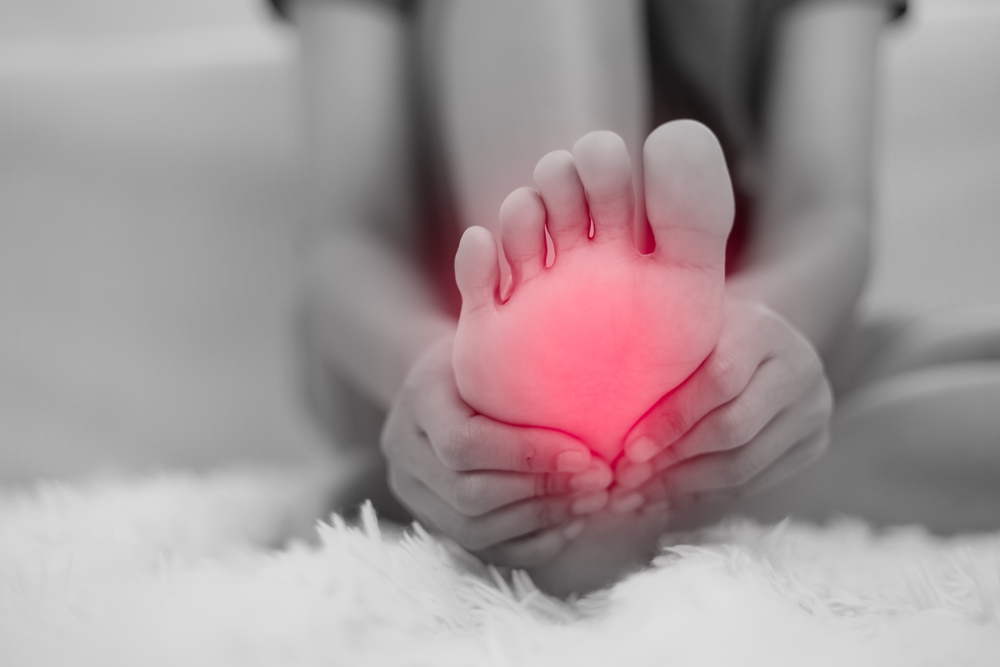
That Sharp Heel Pain When You Take Your First Steps in the Morning?
That first step out of bed feels like stepping on a tack or a deep bruise in your heel. After a few minutes it loosens up, so you ignore it. Then it comes back at the end of a long day, or every time you stand up after sitting. This is the most common pattern we see, and it is almost always plantar fasciitis.
It is the number one cause of heel pain, and it affects all kinds of people. Runners training for their next race, golfers who walk 18 holes, professionals on their feet all day, parents chasing kids around on weekends. If you are active and your heel is keeping you from doing the things you want to do, that is reason enough to get it sorted. Most cases get better without surgery once you know what you are dealing with and treat it the right way. Our podiatrists see heel pain every day at our Coon Rapids and Golden Valley offices, and we treat patients from across the north and west metro, including Maple Grove, Ham Lake, Andover, Champlin, Blaine, Plymouth, Wayzata, Minnetonka, St. Louis Park, and Edina.
Had heel pain for more than two or three weeks?
Get it looked at. Plantar fasciitis is much easier to treat early. Let it run for months and it gets stubborn.
Call 763-421-7300 or Book Online
same-week appointments available at both Coon Rapids and Golden Valley.
What Is Plantar Fasciitis?
The plantar fascia is a thick band of tissue running along the bottom of your foot, from the heel to the base of the toes. It works like a bowstring that supports your arch. When it gets overloaded, small tears and irritation build up where it attaches to the heel, and that is what hurts. Most people describe it as a stone bruise or a sharp stab right under the heel.
You may have heard this called a heel spur. A heel spur is a small bit of bone that can form where the fascia pulls on the heel, but the spur itself usually is not the problem — the inflamed tissue is. Plenty of people have spurs and no pain at all. (More on our Heel Spurs page.) It is also worth knowing that not every sore heel is plantar fasciitis. Stress fractures, pinched nerves, arthritis, and tendon problems can feel similar, which is why it is worth getting an actual diagnosis instead of guessing.
What Causes Plantar Fasciitis?
Plantar fasciitis usually comes down to how your foot is built and how hard you are asking it to work. The things that tend to bring it on:
- Flat feet or very high arches — both change how load travels through the fascia
- Standing or walking on hard floors all day, especially in unsupportive shoes
- Ramping up running or workouts faster than your feet adapt
- Tight calves, which pull on the heel and the fascia with every step
- Extra weight, including weight gained recently or during pregnancy
- Shoes that are worn out, flat, or have no arch support
Symptoms of Plantar Fasciitis
The pattern is usually pretty recognizable:
- Pain under the heel or along the arch
- Worst with the first steps in the morning, or after you have been sitting a while
- Eases up after walking around, then creeps back the longer you are on your feet
- A sharp stab or a deep ache, sometimes both
- Tenderness if you press right on the heel
- Pain that has slowly gotten worse over weeks or months rather than starting all at once
If your heel feels better while you are moving but punishes you afterward, that is classic plantar fasciitis.
One caution: a few other problems can mimic this — Achilles trouble, a pinched nerve, even a stress fracture. They are treated differently. A quick exam sorts out which one you actually have so you are not throwing treatments at the wrong thing.
How Is Plantar Fasciitis Diagnosed?
Diagnosis is mostly hands-on. We talk through your history, look at how you walk, check your arch, and press around the heel to pinpoint where it hurts. That alone tells us a lot. When we need more detail, we use imaging:
- X-ray to check for a spur or rule out a fracture
- Ultrasound may be utilized in office to visualize the fascia and how thick or inflamed it is
- MRI in the occasional stubborn case where we need a closer look at the soft tissue
Treatment Options at Family Foot & Ankle Clinic
Most people get better with simple, conservative care. We start there and only move up a level if your heel is not cooperating. Here is how that progression usually looks.
Tier 1 — First-Line Home Care (Start These Right Away)
Back off the aggravating activity. You do not have to stop moving. Swap running or jumping for swimming or cycling for a bit so the tissue can settle.
Follow a structured home care program. Stretching, night splint use, foam rolling, and knowing when to ice versus heat all work together. Most people who do one thing inconsistently get inconsistent results. We give every plantar fasciitis patient a complete home care program covering all of it — see our Plantar Fasciitis Home Care Program below.
Stop walking around barefoot. Bare feet on hard floors are rough on an irritated fascia. Keep supportive shoes or arch-support sandals on, even just around the house.
Wear shoes that actually support you. Good arch support and a slightly raised heel make a real difference. See our Shoe Recommendations Guide for our current picks by category — including running shoes, walking shoes, sandals, house shoes, and what to look for if you are wearing custom orthotics.
Anti-inflammatories. Over-the-counter ibuprofen can take the edge off in the short term. Follow the label, and check with us if you have any reason to be cautious about them.
Tier 2 — In-Office Treatments (When Home Care Is Not Enough)
If a few weeks of home care has not moved the needle, this is where we step in with more:
Custom orthotics. These are inserts molded to your foot that fix the mechanics driving the problem in the first place. For flat feet, high arches, or heavy overpronation, they are usually the difference between the pain staying gone and coming right back. More on our Custom Orthotics page.
Cortisone injection. For a heel that is really inflamed and not settling, a targeted injection can calm it down. We use these selectively, not as a first move.
Walking boot. For a really angry heel, a few weeks in a removable boot takes the load off completely and lets things calm down.
Physical therapy. A short course of PT can rebuild strength and flexibility through the foot and ankle, which makes a relapse less likely.
Tier 3 — Advanced Option: Shockwave Therapy (EPAT) for Chronic Heel Pain
Shockwave therapy (EPAT). When heel pain has dragged on and the usual treatments have not fixed it, shockwave is often what finally does — but there is an important reason not to think of it as a last resort only. Shockwave works by sending acoustic pressure waves into damaged tissue to stimulate healing and break down the thickening and scarring that builds up in a chronically inflamed fascia. That is the key word: chronic. Shockwave is most effective when the tissue has already thickened and scarred, which is exactly what happens the longer plantar fasciitis goes untreated. Cortisone injections and anti-inflammatories mask pain but do nothing about those underlying tissue changes — shockwave targets them directly. The practical implication: if your heel pain has been going on for more than a few months, shockwave is worth discussing sooner rather than waiting until everything else has failed. No needles, no surgery, no downtime. You walk in and out. Most patients do a series of six sessions. Heads up: insurance usually does not cover shockwave, so it is a cash-pay service. We offer package pricing and are happy to walk you through the options. → See our Shockwave Therapy (EPAT) page.
When Is Surgery Needed?
Surgery for plantar fasciitis is rare. Better than nine out of ten people never need it. It only comes up after you have given conservative treatment a real run and the heel still is not right.
If you do reach that point, we will lay out the options and the tradeoffs honestly and help you decide. But that is the last stop, not the first, and most people never get there.
Long-Term Care & Prevention
Here is the catch with plantar fasciitis: if the thing that caused it is still there, it can come back. Once your heel feels good again, keep a few habits going:
- Stay in supportive shoes and keep avoiding long barefoot stretches on hard floors
- Keep stretching the calf and arch — it only takes a couple minutes
- Wear your orthotics. They are fixing the mechanics, not just masking pain
- Keep your weight in a healthy range, since extra load goes straight through the heel
- Build up mileage and intensity gradually instead of in big jumps
Frequently Asked Questions
How long does plantar fasciitis take to heal?
The length of time it takes to get better is usually proportional to how long you have had the problem. If you start treating it early and stay consistent, most people turn the corner in six to eight weeks. If you have been limping along with it for a year before doing anything, expect more like three to six months. The single biggest factor is how soon you start.
Can I still walk and work out with it?
Yes, within reason. Ease off the high-impact stuff that lights it up — running, jumping, long days standing — and lean on swimming or cycling for now. We will give you more personalized recommendations based on how bad your pain is.
Do I actually need custom orthotics, or will the drugstore kind work?
For a mild case, a quality over-the-counter arch support is a reasonable first try. But if your arch is the real problem — flat feet, high arches, heavy pronation — an off-the-shelf insert can only do so much. Custom orthotics are made for your foot and tend to be what keeps the pain from coming back.
What’s the deal with heel spurs — isn’t that what’s hurting?
Usually not. The spur is just bone that formed where the fascia tugs on the heel. Lots of people have one and feel nothing. The pain is from the inflamed or chronically thickened fascia, so that is what we treat. Cutting out a spur is almost never necessary.
Does shockwave therapy really work?
For chronic plantar fasciitis that has not responded to other things, the evidence is solid — studies put success around 70 to 80 percent. It works by jump-starting your body’s own healing. Most people do six sessions. We will tell you honestly at your visit whether you are a good candidate.
I’ve had this for years. Is it too late?
Not at all. Even heel pain you have lived with for years often responds once it is treated properly — frequently with shockwave or a fresh round of orthotics and physical therapy. If you have already been treated somewhere else and it did not help, that is exactly the kind of case our Second Opinion / Foot Pain Not Improving visit is built for.
Done Limping Around on a Sore Heel? Let’s Fix It.
Book an appointment at our Coon Rapids or Golden Valley office and we will figure out what is going on and get you a plan that works!
Call 763-421-7300 or Book Online