
Stiff, Painful Big Toe — Especially Going Up Stairs or Pushing Off When You Walk
Hallux rigidus is the medical term for arthritis of the first metatarsophalangeal (MTP) joint — the large joint at the base of the big toe. It is the most common arthritic condition of the foot, and it is also one of the most commonly under-managed. Patients often attribute the stiffness and ache to normal aging, compensate by walking differently, and arrive at our office years later with significantly more joint degeneration than they would have had with earlier intervention.
The defining feature is progressive loss of dorsiflexion — the upward bend of the big toe. Every normal step requires the big toe to bend approximately 65 degrees at push-off. When arthritis limits that motion, the body compensates: people roll off the inside of the foot, develop knee and hip pain from altered gait, and avoid activities they used to enjoy. Our podiatrists evaluate and treat hallux rigidus at our Coon Rapids and Golden Valley offices, serving patients across the north and west metro including Maple Grove, Champlin, Blaine, Plymouth, Wayzata, Minnetonka, and Edina.
Hallux rigidus is a progressive condition. It does not improve without treatment and tends to worsen over time. The earlier the grade at which it is managed, the more conservative the treatment options. By Grade 3–4, the joint has significant structural damage and surgical options shift from joint-preserving to joint-destructive. Getting evaluated early gives you more choices.
Call 763-421-7300 or book online
Hallux Limitus vs. Hallux Rigidus — What’s the Difference?
Both terms describe arthritis and reduced motion of the first MTP joint, but they represent different stages of the same progressive condition:
- Hallux limitus: reduced range of motion at the first MTP joint, but some motion remains. The joint is stiff and painful with push-off activities, but the big toe can still bend to some degree. May be functional (only limited during weight-bearing) or structural (limited in both weight-bearing and non-weight-bearing positions).
- Hallux rigidus: advanced stage with near-complete loss of motion. The joint is essentially fused by bone spurs and cartilage loss. Even passive movement is minimal and painful. At this stage the joint has significant structural damage.
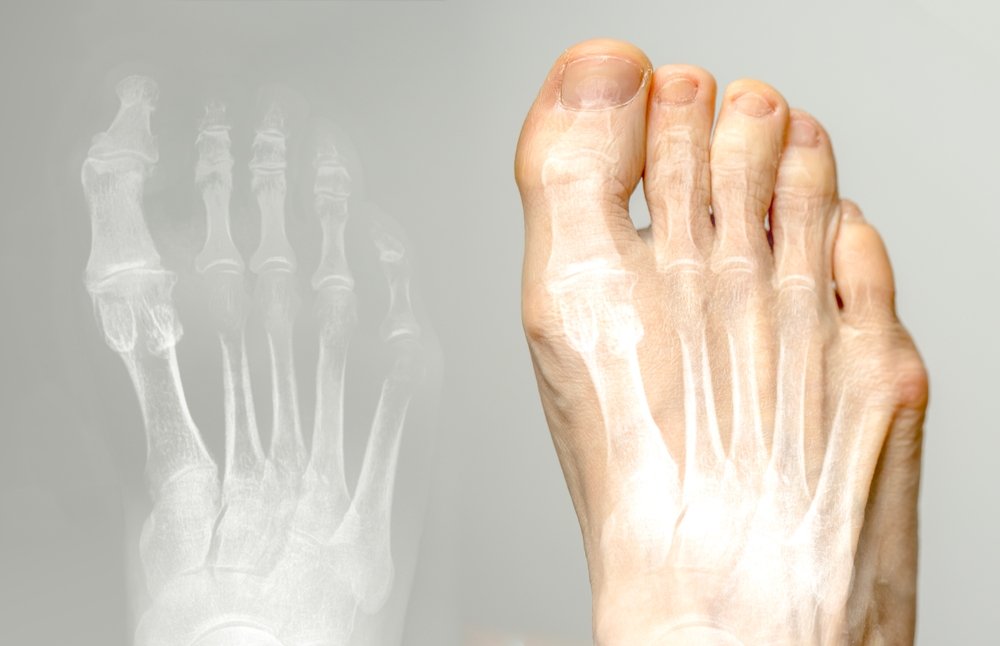
Both conditions involve the formation of dorsal osteophytes — bone spurs on the top of the joint — that impinge on the joint during bending. These spurs are visible on X-ray and are the primary structural finding. They also create a palpable bump on top of the big toe joint that patients sometimes mistake for a bunion.
This is not the same as gout. Acute gout can cause sudden, severe, red, hot swelling at the first MTP joint and is one of the most common causes of acute big toe joint pain. Hallux rigidus causes chronic, progressive stiffness and aching that worsens gradually. Both can occur in the same patient. If your big toe joint has sudden, explosive onset pain with redness and heat, seek evaluation for gout before assuming it is arthritis.
Grading — How Severe Is Your Hallux Rigidus?
The Coughlin-Shurnas grading system classifies hallux rigidus from 0 to 4 based on range of motion, symptoms, and X-ray findings. The grade determines the appropriate treatment:
| Grade | What It Means | Typical Treatment |
| Grade 0 | Stiffness and pain only at extremes of motion. Big toe still moves well. X-ray normal or near-normal. | Footwear modification, activity monitoring. |
| Grade 1 — Mild | Mild pain with activity. Small bone spur visible on X-ray. Some joint space remaining. | Rocker-sole shoes, orthotics with Morton’s extension, NSAIDs, cortisone injection. |
| Grade 2 — Moderate | Moderate pain and stiffness affecting daily activities. Significant bone spur. Joint space narrowing. | Same as Grade 1. Cheilectomy surgery if conservative care fails. |
| Grade 3 — Severe | Constant pain. Motion nearly gone. Severe bone spur and cartilage loss. | Cheilectomy with osteotomy, or joint fusion (arthrodesis). |
| Grade 4 — End-Stage | Bone-on-bone. Essentially no motion. Severe disability. | Arthrodesis (fusion) is the standard. Implant arthroplasty in selected patients. |
Causes & Risk Factors
- Prior trauma: injury to the first MTP joint — sprains, turf toe, intra-articular fractures — is the most common identifiable cause, often presenting years after the original injury.
- Genetics and foot structure: a flat or chevron-shaped metatarsal head, a long first metatarsal, and family history all increase risk.
- Repetitive overuse: squatting, kneeling, running, ballet, golf, and manual labor requiring repeated big toe hyperextension accelerate joint degeneration.
- Prior gout flares: repeated uric acid crystal deposition in the first MTP joint causes cumulative cartilage damage.
- Inflammatory arthritis: rheumatoid arthritis and other inflammatory conditions can drive rapid first MTP joint destruction.
Symptoms
- Stiffness and aching at the base of the big toe, worse with walking, running, or prolonged standing
- Pain specifically with push-off — when the big toe must bend upward at the end of each step, going upstairs, or walking uphill
- A palpable bump on top of the big toe joint from the dorsal osteophyte — sometimes mistaken for a bunion
- Swelling at the joint after activity, and numbness or tingling on the top of the toe from the dorsal nerve being compressed by bone spurs
- In advanced stages: pain at rest, visible toe-down gait compensation, and activity avoidance
Diagnosis
Diagnosis combines clinical examination with weight-bearing X-rays. We assess range of motion (both passive and active), the location and character of pain, the presence and size of dorsal osteophytes, and the overall joint alignment. Gripping the proximal phalanx and attempting to dorsiflex the toe while the patient bears weight reproduces the pain and demonstrates the motion deficit precisely.
Weight-bearing X-rays are essential — they show the joint space under load, the size and location of osteophytes, and the degree of cartilage loss. MRI is occasionally used when the extent of cartilage damage needs to be characterized before surgical planning.
Treatment at Family Foot & Ankle Clinic
Conservative Management — Grades 0–2
Rocker-sole footwear. The single most impactful conservative intervention. A rocker sole curves upward under the forefoot, allowing forward momentum to transfer through the shoe rather than requiring the big toe to bend. This significantly reduces pain with walking for most Grade 1–2 patients. See our Shoe Recommendations Guide for specific current picks.
Custom orthotics with Morton’s extension. A Morton’s extension is a rigid carbon fiber or firm plastic plate built into the orthotic that extends under the big toe, preventing MTP joint dorsiflexion and eliminating the painful impingement motion. This is one of the most effective conservative tools for hallux rigidus and can provide lasting relief for Grade 1–2 patients who also need arch support or gait correction. More on our Custom Orthotics page.
NSAIDs and icing. Anti-inflammatory medications and ice reduce acute pain and joint inflammation, particularly after activity. Useful for symptom management rather than disease modification.
Corticosteroid injection. An injection into the first MTP joint provides significant short-to-medium term relief, particularly during flares or for acute exacerbations. Typically lasts weeks to months. Used selectively — repeated injections can accelerate cartilage loss.
Surgical Options — Grade 2 Failing Conservative Care, and Grades 3–4
Surgical options are matched to the grade of disease:
- Cheilectomy (Grade 1–2, early Grade 3): the dorsal osteophytes (bone spurs) are surgically removed from the top of the joint, restoring range of motion. The joint itself is preserved. The most conservative surgical procedure for hallux rigidus and has excellent outcomes when the underlying cartilage is still reasonably intact. Recovery typically 4–6 weeks.
- Cheilectomy with Moberg osteotomy (Grade 2–3): a wedge of bone is removed from the base of the proximal phalanx to tilt the effective range of the joint into a more functional position. Combined with cheilectomy for patients who have moderate joint damage but adequate remaining cartilage.
- Arthrodesis — first MTP fusion (Grade 3–4): the gold standard for advanced hallux rigidus. The joint surfaces are resected and the bones are fused in a functional position using plates and screws. Eliminates pain definitively. The patient loses big toe motion permanently but walks normally with appropriate footwear. High patient satisfaction.
- Implant arthroplasty (selected patients): a synthetic joint replacement preserves some big toe motion. Reserved for carefully selected patients where fusion is not preferred. Less predictable long-term outcomes than fusion; not appropriate for high-demand patients.
See our Foot & Ankle Surgery Overview for general information on surgical care at our clinic.
Frequently Asked Questions
Can big toe arthritis be reversed?
No. Cartilage, once lost, does not regenerate. Conservative treatment manages pain and slows progression; surgery removes the mechanical impingement (cheilectomy) or eliminates joint motion (fusion). Early management preserves more cartilage and more options — Grade 1 patients who manage well may avoid surgery for years, while Grade 3 patients have significantly fewer choices.
Will I be able to walk normally after big toe fusion?
Yes. First MTP arthrodesis consistently produces high patient satisfaction. The toe is fused in a functional position that allows a normal gait pattern in appropriate footwear. Most patients find the quality of life improvement significantly outweighs the permanent loss of joint motion — which in advanced disease was already essentially absent.
Is this the same as gout?
No. Gout causes sudden, acute, intensely painful inflammatory flares from uric acid crystals. Hallux rigidus causes chronic, progressive arthritic stiffness and aching. Both can coexist in the same patient — prior gout flares accelerate arthritic degeneration. An X-ray and uric acid blood test together typically clarify the picture. See our Gout page.
Big Toe Pain and Stiffness That’s Changing How You Walk? Don’t Wait for It to Get Worse.
Hallux rigidus is significantly easier to treat at Grade 1 than at Grade 3. A weight-bearing X-ray and a clinical exam tell us exactly where you are in that progression. Book an appointment at our Coon Rapids or Golden Valley office and we will give you a clear picture and a practical plan.
Call 763-421-7300 | Book online
Serving Coon Rapids, Golden Valley, Maple Grove, Champlin, Blaine, Plymouth, Andover, Wayzata, Minnetonka, Edina, and all Twin Cities communities.
Related Services & Conditions
- Bunions (Hallux Valgus)
- Gout
- Hammertoes
- Morton’s Neuroma
- Custom Orthotics
- Foot & Ankle Surgery Overview
- Second Opinion / Foot Pain Not Improving