
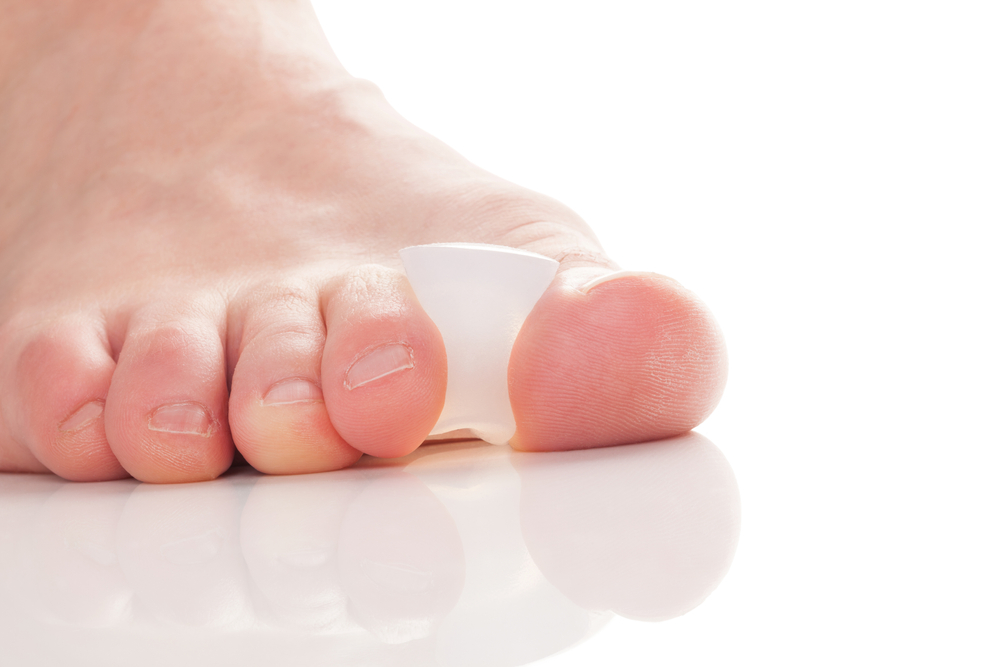
A Bony Bump on the Outside of Your Foot at the Little Toe
Most people have heard of a bunion — the bony bump that develops at the base of the big toe. Fewer know that a nearly identical condition can develop on the opposite side of the foot. A tailor’s bunion, also called a bunionette, is a prominence at the base of the fifth metatarsal head, right where the little toe meets the foot. It causes the same characteristic bump, the same rubbing against shoes, and the same progressive discomfort as a standard bunion — just on the lateral rather than the medial side.
The name comes from an occupation. Tailors historically sat cross-legged for long hours with the outer edge of their foot pressed against the floor, creating chronic pressure on that spot. Modern patients develop it for a different reason entirely: inherited foot mechanics that cause the fifth metatarsal to drift outward, combined with footwear that compresses the already-prominent bump. Our podiatrists diagnose and treat tailor’s bunions at our Coon Rapids and Golden Valley offices, serving patients across the north and west metro including Maple Grove, Champlin, Blaine, Plymouth, Wayzata, Minnetonka, and Edina.
Like a standard bunion, a tailor’s bunion is a structural deformity that does not resolve without surgery. Conservative treatment manages pain and slows progression. Surgery is the only way to correct the deformity itself. Getting an early evaluation gives you the most options.
Call 763-421-7300 or book online
What Is a Tailor’s Bunion?
A tailor’s bunion develops when the head of the fifth metatarsal — the long bone that leads to the little toe — drifts outward (laterally) while the little toe drifts inward (medially). This misalignment creates a prominent bump on the outer edge of the foot at the fifth metatarsal head. Two structural variants exist:
- Fifth metatarsal head enlargement / lateral bowing: the metatarsal head itself is enlarged or the shaft bows outward, making the head more prominent at the outer foot margin. The more common presentation.
- Bony spur variant: instead of a bowed or enlarged metatarsal head, an outgrowth of bone (exostosis) develops on the side of the fifth metatarsal head. This variant is structurally different but produces similar symptoms and responds to similar management.
The bump becomes symptomatic when shoes press against it. The skin over the prominence can develop a corn or callus from repeated friction, adding to the discomfort. The fifth metatarsophalangeal (MTP) joint can also develop bursitis — inflammation of the fluid-filled sac over the bump — during flares.
Tailor’s bunion and standard bunion can coexist. Some patients have both a medial bunion at the first metatarsal and a tailor’s bunion at the fifth — a combination sometimes called a “splay foot.” This is more common in patients with a broad, hypermobile forefoot. Evaluation and X-rays of the full forefoot are important when both are suspected.
Causes & Risk Factors
- Inherited foot structure: the primary driver. A foot type that allows the fifth metatarsal to drift laterally is genetic — the same hereditary pattern that underlies hallux valgus bunions at the first metatarsal.
- Narrow, pointed, or tight-fitting footwear: does not cause the deformity but accelerates progression and triggers symptoms by pressing against the prominent fifth metatarsal head.
- Splayed forefoot: a wide, hypermobile forefoot in which all five metatarsals spread apart under load, increasing the prominence of both the first and fifth metatarsal heads.
- High-heeled shoes: increase the forefoot pressure load and compressive forces across the outer foot.
Symptoms
- A visible and palpable bony prominence on the outer edge of the foot at the base of the little toe
- Pain, redness, and swelling at the site — typically worsened by shoes that press against the bump
- A corn or callus over the prominence from repeated friction with shoe leather
- Bursitis flares — acute episodes of warmth, swelling, and increased pain, often triggered by prolonged activity in narrow shoes
- Little toe that angles inward toward the fourth toe
- Difficulty finding shoes that do not press on the outer foot
Important: pain at the base of the fifth metatarsal that came on suddenly after an ankle roll or inversion injury may be a tuberosity avulsion fracture rather than a tailor’s bunion — these are different conditions at adjacent locations. Imaging distinguishes them. If pain came on after a twisting injury rather than gradually, get an X-ray.
Diagnosis
The prominence is usually visible on examination. We take weight-bearing X-rays of the forefoot to identify which structural variant is present — lateral bowing of the fifth metatarsal shaft, an enlarged metatarsal head, or an exostosis — and to measure the fourth-fifth intermetatarsal angle, which determines the degree of deformity and guides surgical planning. We also assess the fifth MTP joint for arthritic changes and evaluate the overall forefoot width and alignment.
Treatment at Family Foot & Ankle Clinic
Conservative Management
Footwear modification. The single most impactful immediate change. Shoes with a wide, rounded toe box that does not press on the fifth metatarsal head reduce or eliminate irritation without any other intervention. Avoiding pointed toe boxes, tight dress shoes, and heels above 1–2 inches is essential during any symptomatic period. See our Shoe Recommendations Guide for current wide-toe-box picks.
Padding. Bunionette pads placed over the fifth metatarsal head reduce direct shoe pressure and friction. Donut-style pads that protect the prominence without compressing it are most effective. Available through our office or from MyFootShop.com — search “Tailors Bunion Pads” in the Bunion Products category.
Anti-inflammatories and icing. NSAIDs and ice (15 minutes, wrapped in a thin towel, several times per day) manage acute bursitis flares. Most effective when combined with footwear correction rather than used as standalone treatments.
Custom orthotics. For patients with a splayed or hypermobile forefoot, a custom orthotic with a metatarsal pad or lateral wedging can redistribute forefoot load and reduce the compressive forces driving the fifth metatarsal outward. More on our Custom Orthotics page.
Corticosteroid injection. An injection into the fifth MTP bursa provides significant short-term relief during an acute flare. Used selectively rather than as routine management.
Surgical Correction
Surgery is recommended when conservative treatment no longer adequately controls pain and functional limitation persists despite footwear and padding modifications. The surgical approach depends on the structural variant:
- Lateral condylectomy (shaving): removal of the prominent portion of the fifth metatarsal head. Appropriate for mild deformities or the bony spur variant where the structural alignment is otherwise acceptable. Shorter recovery than osteotomy procedures.
- Fifth metatarsal osteotomy: a cut is made in the fifth metatarsal bone and it is repositioned medially to reduce the intermetatarsal angle and correct the alignment. Comparable in principle to the first metatarsal osteotomy used for hallux valgus, but the fifth metatarsal’s smaller size and different blood supply require careful technique.
- Diaphyseal osteotomy (for lateral bowing variant): when the deformity is due to bowing of the metatarsal shaft rather than head enlargement, the osteotomy is performed at the site of maximal bowing to straighten the bone.
Recovery depends on the specific procedure. Most patients are weight-bearing in a surgical shoe or boot within days, with return to regular footwear at 4–6 weeks and full activity at 6–10 weeks for condylectomy, or 8–12 weeks for osteotomy procedures.
See our Foot & Ankle Surgery Overview for general information on surgical care at our clinic.
Frequently Asked Questions
Is a tailor’s bunion the same as a regular bunion?
Same principle, different location. A standard bunion (hallux valgus) is a structural deformity at the first metatarsal head on the inner side of the foot. A tailor’s bunion is a structural deformity at the fifth metatarsal head on the outer side. Both are hereditary, both are progressive, neither resolves without surgery, and both are managed with the same conservative principles — wide footwear, padding, orthotics, and anti-inflammatories. The surgical procedures are anatomically distinct since they involve different metatarsals, but the goals are the same.
Will it go away on its own?
No. Like a standard bunion, a tailor’s bunion is a structural deformity that does not resolve without surgical correction. The bump may become less inflamed with appropriate footwear changes, but the underlying bony misalignment will not improve and will typically worsen over time. Conservative treatment keeps it comfortable; surgery corrects it.
My shoe is rubbing a corn on the outside of my foot. Is that from the tailor’s bunion?
Almost certainly yes. A corn or callus that develops specifically on the outer edge of the foot at the base of the little toe is the direct result of shoe friction against the fifth metatarsal prominence. Treating the corn without addressing the underlying deformity that creates the pressure will not solve the problem — the corn will keep returning. Footwear with a wider toe box, protective padding, and evaluation of the deformity are the right first steps.
Do I need surgery?
Not necessarily, and not urgently. Many patients manage tailor’s bunions comfortably for years with the right footwear and padding. Surgery becomes the conversation when conservative measures are no longer providing adequate relief and the pain is affecting daily life or footwear choices. If you have been struggling with it for a while and are not sure what your options are, our Second Opinion / Foot Pain Not Improving visit is a useful starting point for an independent assessment.
Outer Foot Bump Causing Pain or Shoe Problems? Let’s Sort It Out.
Whether you are looking for better conservative management or want to discuss surgical correction, the first step is an evaluation with weight-bearing X-rays so we know exactly what type of deformity we are dealing with. Book an appointment at our Coon Rapids or Golden Valley office.
Call 763-421-7300 or book online
Serving Coon Rapids, Golden Valley, Maple Grove, Champlin, Blaine, Plymouth, Andover, Wayzata, Minnetonka, Edina, and all Twin Cities communities.