
Stubbed, Dropped Something On It, or Rolled Your Foot — Is It Broken?
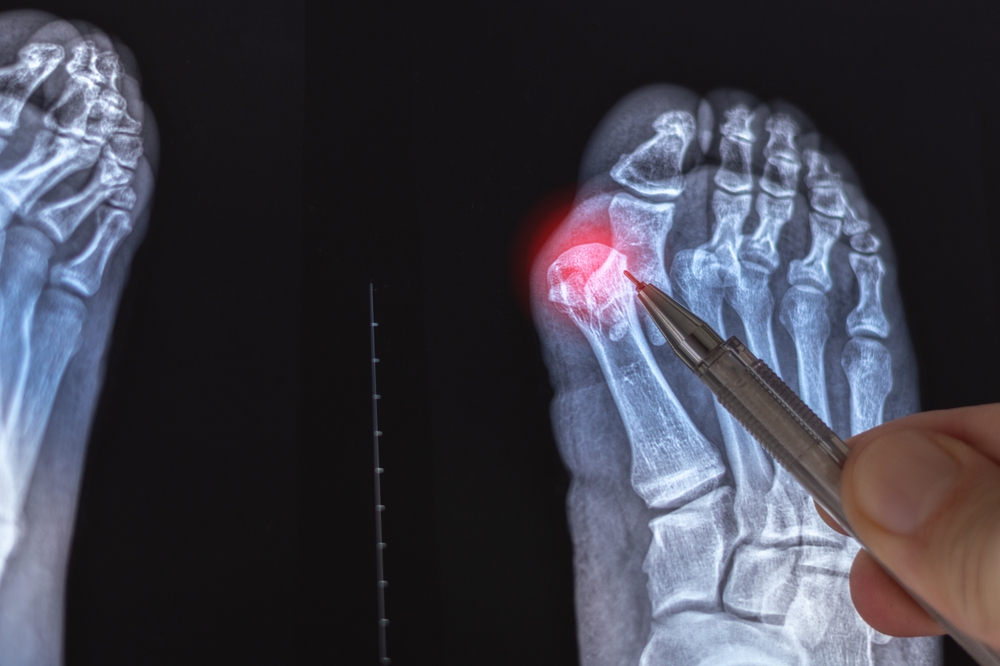
Broken toes and metatarsal fractures are among the most common foot injuries, and also among the most commonly undertreated. The widespread advice to “tape it and wait” is right for some fractures and completely wrong for others. A Jones fracture — a break at the base of the fifth metatarsal — has a high non-union rate and often requires surgery. A simple toe fracture that is displaced or involves the great toe joint may need reduction and splinting. Knowing which type you have matters.
Our podiatrists see and treat toe and metatarsal fractures at our Coon Rapids and Golden Valley offices, serving patients across the north and west metro including Maple Grove, Ham Lake, Andover, Champlin, Blaine, Plymouth, Wayzata, Minnetonka, St. Louis Park, and Edina.
Get an X-ray if: you cannot bear weight, you have significant swelling and bruising, the toe looks visibly deformed or angled, or pain is not improving within 48 hours. The Ottawa Foot Rules specifically flag tenderness at the base of the fifth metatarsal as an indication for imaging — this is the Jones fracture zone, and it should not be assumed to be a sprain.
Call 763-421-7300 or book online
Types of Toe & Metatarsal Fractures
Not all fractures in this region are managed the same way. The table below shows the key distinctions:
| Fracture Type | How It Happens | Key Concern | Typical Management |
| Lesser toe fractures (2nd–5th toes) | Direct impact — stubbing, dropping an object, kicking something hard | Usually low-risk. Displacement or involvement of the joint surface changes management. | Buddy taping 3–4 weeks. Stiff-soled shoe. Reduction needed if significantly displaced. Rarely requires surgery. |
| Great toe (hallux) fracture | Higher-energy impact. Often involves the interphalangeal joint. | The great toe carries 50% of push-off force. Articular fractures heal poorly if malpositioned. | Reduction if displaced. Hard-soled shoe or boot 4–6 weeks. Surgery for articular fractures that cannot be reduced and held. |
| Metatarsal shaft fractures (2nd, 3rd, 4th) | Direct crush, twisting fall, or repetitive stress (stress fracture) | Usually stable if not displaced. Multiple metatarsal fractures increase instability risk. | Walking boot or stiff shoe 4–6 weeks. Surgery if significantly displaced or multiple metatarsals fractured. |
| Fifth metatarsal tuberosity avulsion | Ankle inversion injury — the peroneus brevis tendon pulls off a fragment of bone at the base of the fifth metatarsal | Often mistaken for an ankle sprain. Generally heals well as it is outside the watershed zone. | Walking boot or stiff shoe 4–6 weeks. Surgery very rarely needed. |
| Jones fracture (fifth metatarsal proximal shaft) | Sudden inversion, pivoting, or lateral stress. Common in basketball, football, soccer. | HIGH RISK: located in a watershed zone with poor blood supply. High non-union rate with conservative treatment alone. | Non-weight-bearing cast 6–8 weeks minimum OR surgical fixation with intramedullary screw — especially for athletes and active patients. Do not ignore or tape and rest. |
The Jones fracture is the injury to know. It occurs just distal to the tuberosity avulsion, in the proximal shaft, where blood supply is poor. Patients are often told they “just sprained their ankle” after an inversion injury, treated without imaging, and present weeks later with a non-union. If you have had persistent outer foot pain after a twisting injury and have not had an X-ray, get one. If you have a Jones fracture and have been put in a boot without surgical discussion, ask whether that is the right choice for your activity level.
Diagnosis
Diagnosis combines physical examination with imaging. We assess point tenderness, deformity, range of motion at the involved joint, and whether the fracture is intra-articular.
- X-ray — Identifies fracture location, displacement, and alignment.
- CT scan — for complex articular fractures, or when the Jones fracture geometry needs to be characterized before deciding on surgical vs. conservative management.
- MRI — when a stress fracture is suspected but X-ray is negative, or when soft tissue injury alongside the fracture needs to be assessed.
Treatment at Family Foot & Ankle Clinic
Conservative Management
Buddy taping: the standard treatment for most lesser toe fractures. The fractured toe is taped to the adjacent toe, which acts as a splint. Effective for non-displaced, non-articular fractures of the 2nd through 5th toes. Maintained for 3–4 weeks with a stiff-soled or wide shoe.
Stiff-soled shoe or walking boot: reduces the bending forces through the forefoot during walking. Used for metatarsal shaft fractures, tuberosity avulsions, and great toe fractures that are non-displaced.
Fracture reduction: displaced toe fractures may be reduced (realigned) in-office under local anesthesia. Maintaining reduction requires proper splinting and footwear, and is checked with repeat X-rays at 1–2 weeks.
Non-weight-bearing: Jones fractures managed conservatively require strict non-weight-bearing in a cast for 6–8 weeks. Partial loading during this period is the most common reason Jones fractures fail to heal.
Surgical Management
Surgery is indicated for:
- Jones fractures in athletes, active patients, or anyone who needs reliable union on a defined timeline — intramedullary screw fixation is the standard.
- Significantly displaced metatarsal shaft fractures or multiple metatarsal fractures that are unstable
- Articular fractures of the great toe that cannot be reduced and held in anatomic alignment
- Any fracture failing to heal after appropriate conservative management
See our Foot & Ankle Surgery Overview for general information on what surgical care at our clinic involves.
Healing & Return to Activity
Healing timelines depend on fracture location, severity, and patient factors including age, nutrition, smoking status, and bone health:
| Fracture Type | Typical Healing Time |
| Lesser toe fracture (non-displaced) | 3–4 weeks buddy-taped |
| Great toe fracture (non-displaced) | 4–6 weeks in boot/shoe |
| Metatarsal shaft (non-displaced) | 4–6 weeks in boot |
| Fifth metatarsal tuberosity avulsion | 4–6 weeks in boot |
| Jones fracture — conservative | 6–8 weeks non-weight-bearing, then rehab |
| Jones fracture — surgical fixation | 6–8 weeks protected, then rehab |
Return to activity is guided by clinical and imaging criteria, not calendar dates alone. A fracture that feels better is not necessarily healed. Repeat X-rays confirm callus formation and fracture union before return to full loading. Premature return is the most common cause of re-fracture and Jones fracture non-union.
Footwear for return to activity: cushioned, supportive shoes with a stiff forefoot reduce stress at the fracture site during the return phase. See our Shoe Recommendations Guide for current picks.
Frequently Asked Questions
Can I just tape a broken toe at home?
For a simple lesser toe fracture that is not visibly deformed and is minimally painful, buddy taping at home is reasonable for the first day or two. But if the toe looks angled, if it involves the great toe, if pain is severe or not improving, or if the injury involved significant force, an X-ray is the right call. You cannot tell whether a fracture is displaced, articular, or a Jones fracture without imaging.
My X-ray showed a “chip” at the base of my fifth metatarsal. Is that serious?
It depends on exactly where. A chip at the very tip of the tuberosity (the bony bump on the outer midfoot) is a tuberosity avulsion — generally low risk, heals well in a boot. A fracture at the proximal shaft, just past the tuberosity, is a Jones fracture — high risk, high non-union rate, and often needs surgical fixation in active patients. The location distinction on the X-ray is a few millimeters and is easy to miss. If you have outer foot pain after a twisting injury and are not sure which one you have, ask us to review your imaging.
How long should I be off my foot?
Lesser toe fractures and most metatarsal shaft fractures allow walking in a stiff shoe or boot from day one. Jones fractures managed conservatively require strict non-weight-bearing for 6–8 weeks. Surgically fixed Jones fractures allow earlier return to weight-bearing than conservative management and are generally the faster path to full activity for active patients.
I was told my Jones fracture is not healing. What are my options?
Jones fracture non-union is common when the fracture is undertreated or when the patient returns to activity too early. Surgical fixation with an intramedullary screw is the standard treatment for non-union, and outcomes are generally very good with surgery even after delayed presentation. If you have been managing a Jones fracture conservatively for more than 8–10 weeks without confirmed healing on imaging, our Second Opinion / Foot Pain Not Improving visit is a useful next step.
Foot Injury That Needs Imaging? Come In.
Most broken toes and metatarsal fractures are straightforward once we know what we are dealing with. The ones that go wrong almost always do so because the wrong fracture type was managed with the wrong treatment. Get it evaluated, get the right imaging, and we will give you a clear plan.
Call 763-421-7300 | Book online
Serving Coon Rapids, Golden Valley, Maple Grove, Champlin, Blaine, Plymouth, Andover, Wayzata, Minnetonka, Edina, and all Twin Cities communities.
Related Services & Conditions
- Ankle Fractures
- Stress Fractures
- Sesamoid Injuries
- Custom Orthotics
- Foot & Ankle Surgery Overview
- Second Opinion / Foot Pain Not Improving