
Yellow, Thick, or Crumbling Toenails — What Is Happening and What Actually Works
Toenail fungus — the medical term is onychomycosis — is one of the most common nail conditions we treat. The fungal organisms responsible, most commonly dermatophytes from the Trichophyton species, infect the nail plate and nail bed, causing the nail to thicken, discolor, and crumble from the inside out. It is not a cosmetic problem that will resolve on its own. Once established, fungal nail infection is persistent and progressive, and it will spread to other nails and to other people if the environment is not also treated.
The other thing most patients do not know: toenail fungus almost always starts as athlete’s foot — a fungal infection of the skin of the foot — and athlete’s foot and contaminated shoes and socks will re-infect a treated nail. Treating the nail without treating the skin and the environment is one of the most common reasons treatment fails. Our podiatrists treat toenail fungus at our Coon Rapids and Golden Valley offices, serving patients across the north and west metro including Maple Grove, Ham Lake, Andover, Champlin, Blaine, Plymouth, Wayzata, Minnetonka, St. Louis Park, and Edina.
Toenail fungus does not resolve on its own and does not respond to home remedies. Although home remedies like vinegar soaks, tea tree oil, and Vicks VapoRub are popular, there is limited high-quality clinical evidence that they reliably cure established fungal toenail infections. Most over-the-counter antifungal nail products do not penetrate the nail well enough to reliably reach the fungus beneath the nail, making them ineffective for most established fungal toenail infections. Effective treatment for established toenail fungus often includes a prescription-strength topical medication designed to optimize nail penetration, an oral antifungal medication, or, when appropriate, nail removal. We can recommend the option that’s best for your specific infection.
Call 763-421-7300 or book online
What Is Onychomycosis?
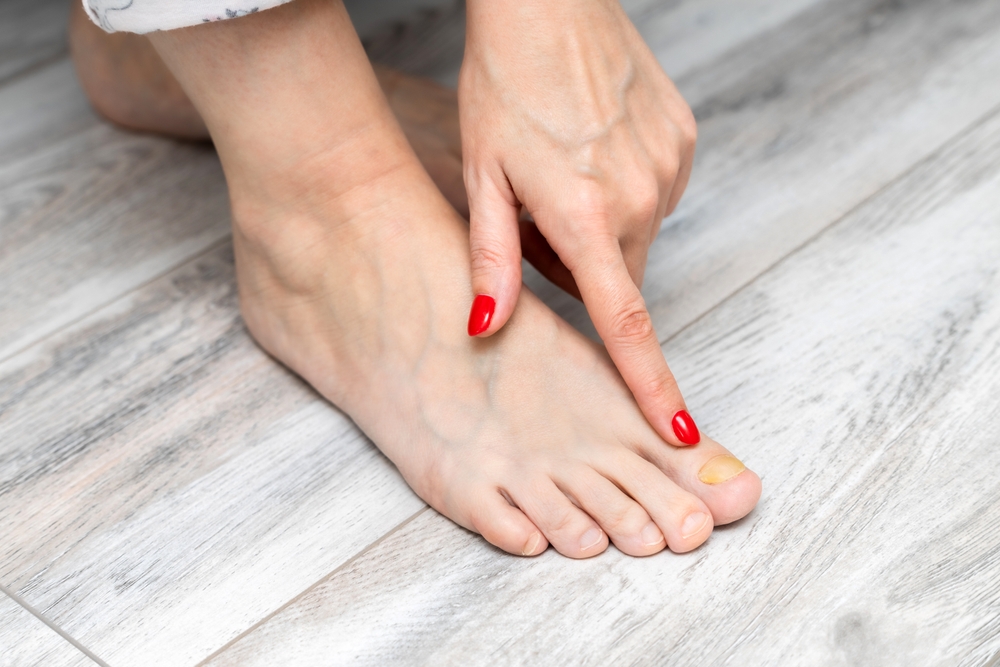
Onychomycosis is a fungal infection of the nail unit — the nail plate, nail bed, and surrounding matrix. Most cases (about 90%) are caused by dermatophytes, particularly Trichophyton rubrum and Trichophyton mentagrophytes. Yeast (Candida) and molds cause most of the remaining cases. The organism penetrates the nail plate, most often starting at the distal or lateral edge, and colonizes the nail bed, producing the characteristic changes:
- Discoloration — white, yellow, yellow-brown, or black depending on the organism and stage
- Thickening of the nail plate from subungual debris (keratin buildup between the nail and nail bed)
- Onycholysis — separation of the nail from the nail bed, often from the free edge inward
- Brittleness, crumbling, or cracking of the nail plate
- Distortion of the nail shape, sometimes with a foul odor from the subungual debris
Important: not all discolored or thickened nails are fungal. Trauma to the nail, psoriasis, bacterial infection, and other conditions can produce similar appearances. An accurate diagnosis — confirmed by nail sample culture or periodic acid-Schiff (PAS) stain on a nail clipping — before starting treatment avoids months of unnecessary antifungal therapy.
The Athlete’s Foot Connection — Why You Must Treat Both
Onychomycosis and tinea pedis (athlete’s foot) are caused by the same organisms. In most cases, toenail fungus originates from an untreated or recurring athlete’s foot infection — the fungus migrates from the skin of the foot to the nail. And after a nail is successfully treated, athlete’s foot on the surrounding skin or in contaminated footwear will re-infect the nail, starting the cycle again.
Concomitant treatment is essential. Treating toenail fungus without simultaneously treating any active athlete’s foot on the surrounding skin is the most common preventable reason treatment fails. Our treatment plan addresses both the nail and the skin in parallel. See our Athlete’s Foot resources below for the skin treatment protocol.
Decontaminating Your Environment — Shoes and Socks
Fungal organisms survive in the warm, dark, moist environment of shoes for months. Treating the nail and skin while continuing to wear contaminated shoes is a setup for reinfection. Environmental decontamination is a required part of any comprehensive treatment plan:
- Antifungal shoe spray: Apply an antifungal shoe spray to the shoe interior after each wearing to kill residual fungal organisms. Allow shoes to dry completely between wearings. Ask us at your visit for our current recommendation.
- Rotate footwear: allow 24–48 hours between wearings for shoes to dry fully. Replace heavily contaminated shoes worn extensively during active infection.
- Socks: moisture-wicking synthetic or wool socks, changed daily and washed in hot water, reduce the warm moist environment fungus thrives in.
- Public surfaces: wear shower shoes in gym locker rooms, pool decks, and hotel showers — the most common source of initial infection and reinfection.
Treatment Options
Treatment depends on the severity of nail involvement, the number of nails affected, patient health factors (particularly kidney and liver function for oral medications), and patient preference. Most cases benefit from a combination approach rather than a single modality.
| Treatment | How It Works | Best For | Key Considerations |
| Prescription Strength Topicals | Best when combined agents such as urea and lactic acid to enhance penetration of the antifungal medication. | Mild to moderate infection. Patients who prefer to avoid oral medication. Maintenance and prevention of reinfection after other treatments. Potential cosmetic benefits if using compounded topical. | Insurance coverage variable for prescription topicals. Prescription-strength topicals available through our office. Takes 6–12 months for full results as the new nail grows out. More effective than OTC antifungals due to penetrating agents if compound solution. Less effective for thick or severely infected nails. |
| Oral Antifungal | Systemic therapy with higher cure rates. Concentrated in the nail bed from the bloodstream. | Moderate to severe infection. Multiple nails affected. Patients with good hepatic and renal function. | Requires liver function check before treatment (if pulsed dosing) and before and during (if continuous dosing). Drug interaction precautions. |
| Nail avulsion (partial or total) | Surgical or chemical removal of the infected nail plate, exposing the nail bed for direct topical antifungal application. Temporary or permanent (matrixectomy). | Severely thickened nails where topical penetration is impossible. Combination with topical therapy to maximize cure rates. Nails causing pain or mechanical problems. | In-office procedure under local anesthesia. Temporary avulsion allows nail to regrow. Often combined with topical antifungal immediately post-procedure. |
Treatment at Family Foot & Ankle Clinic
We begin with a clinical assessment and nail sample when appropriate to confirm the diagnosis and identify the organism before recommending treatment. Our approach for most patients:
- Confirm the diagnosis: clinical examination plus nail sample for culture when the diagnosis is uncertain or when organism identification will guide treatment selection.
- Assess severity and affected nails: mild involvement of one or two nails without significant thickening may be managed differently than ten severely thickened nails in a diabetic patient.
- Discuss treatment options and patient factors: oral medications are the most effective but require consideration of liver function, drug interactions, and patient comorbidities as well as preference. Topicals are safer but take longer and are less effective for severe cases.
- Address athlete’s foot simultaneously: if tinea pedis is present on the skin, we treat it concurrently. Topical antifungal cream to the soles and toe web spaces is prescribed alongside nail treatment.
- Environmental guidance: shoe decontamination and sock protocol should be discussed at your visit. Ask us about current product recommendations.
- Nail debridement: we may thin and trim infected nails to improve topical penetration and reduce the fungal load.
The Most Common Reasons Treatment Fails
Not treating the skin or the shoes. The fungus often lives in the surrounding skin (athlete’s foot) and can survive inside footwear. Even if the nail improves, untreated skin or contaminated shoes can lead to reinfection within months. Treating all potential sources of fungus at the same time is essential for long-term success.
- Stopping oral medication too early: Toenails grow slowly, and successful treatment takes time. Although the nail may begin to look healthier before treatment is complete, it is important to finish the full course of treatment as recommended to maximize the chance of clearing the infection.
- Using Treatments That Don’t Adequately Reach the Infection: The fungus lives beneath the nail, making it difficult to treat with many over-the-counter products. Depending on the severity of your infection, we may recommend a prescription-strength topical formulation designed to improve penetration through the nail, oral medication, or a combination of therapies to maximize treatment success.
- Treating the Wrong Condition: Not every thick or discolored nail is caused by fungus. Nail trauma, psoriasis, eczema, and other nail conditions can closely resemble a fungal infection. When appropriate, a nail sample may be obtained to confirm the diagnosis before treatment is started.
- Reinfection from household contacts or shared surfaces: A family member with untreated athlete’s foot, shared showers, locker rooms, pools, or contaminated footwear can all reintroduce the fungus. Evaluating and treating other sources of infection can help reduce the risk of recurrence.
Frequently Asked Questions
How long does toenail fungus treatment take?
This depends on the treatment and the nail. Oral terbinafine is taken over 12 weeks, but the toenail grows slowly — approximately 1–1.5 mm per month — so a full toenail takes 9–12 months to replace itself. The treated nail grows out from the base while the infected nail grows forward and is eventually clipped off. Full assessment of cure requires waiting until the entire nail has been replaced by new, healthy growth.
Is toenail fungus contagious?
Yes — to other nails, to the skin of the feet (athlete’s foot), and to other people sharing the same floors, showers, and footwear. The organisms survive in warm, moist environments for extended periods. Household precautions — wearing footwear in shared spaces, not sharing nail tools, treating shoes — reduce transmission risk during active infection and treatment.
My toenail has been thick and yellow for years. Is it too late to treat?
No. Long-standing toenail fungus is harder to treat but not untreatable. Severely thickened and distorted nails often benefit from nail avulsion — removing the infected nail plate to allow the nail bed to be treated directly and a new nail to grow in. Combination therapy (oral plus topical) with nail debridement gives the best outcomes even for long-standing cases. Our Second Opinion / Foot Pain Not Improving visit is also appropriate for patients who have tried prior treatment without success.
Embarrassed by Your Toenails or Struggling With Recurrent Fungus? Let’s Build a Plan That Works.
Most toenail fungus cases that fail treatment were managed incompletely — the wrong product, without treating the skin, without addressing the shoes. A proper evaluation and a comprehensive plan that covers all three makes a significant difference. Book an appointment at our Coon Rapids or Golden Valley office.
Call 763-421-7300 or book online
Serving Coon Rapids, Golden Valley, Maple Grove, Ham Lake, Andover, Champlin, Blaine, Plymouth, Wayzata, Minnetonka, St. Louis Park, Edina, and all Twin Cities communities.